If you are planning a home renovation, custom home build, or commercial project in Tampa, one of the first decisions you will face is how to structure your team. Should you hire a general contractor to execute plans designed by someone else — or use a design-build firm that handles both design and construction under one roof?
The answer depends on your project type, budget, timeline, and how much coordination you want to manage yourself. This guide breaks down exactly how both models work in Tampa, what they cost in practice, and which approach is the right fit for your specific situation.
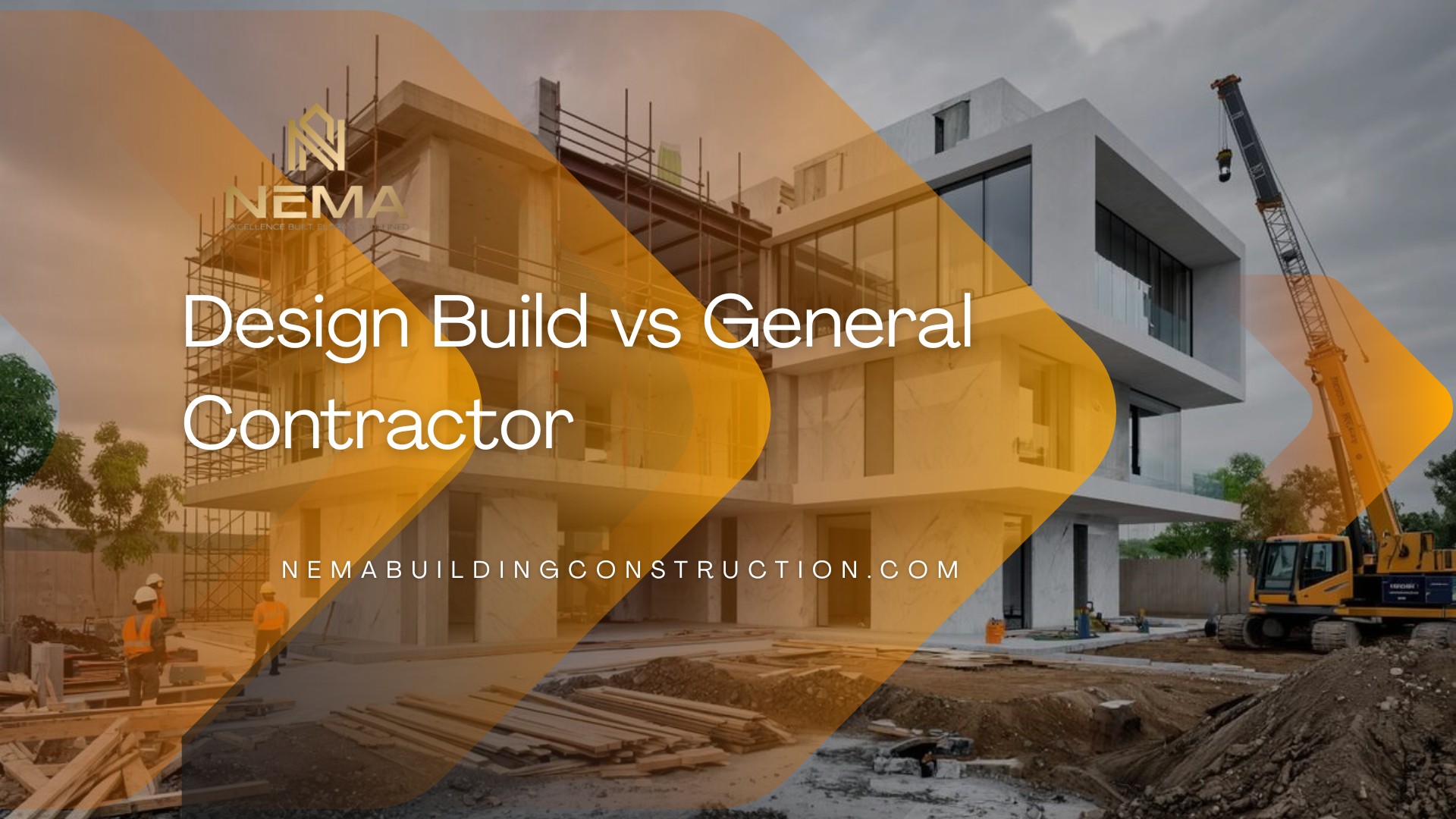
Design-Build vs General Contractor
In a general contractor model, you hire a designer and a builder separately — two contracts, two teams, two schedules. In a design-build model, one firm manages both design and construction under a single contract. Design-build is faster and reduces communication gaps. A general contractor model offers more flexibility if you already have completed plans. For most Tampa renovation and new construction projects in 2026, design-build tends to produce fewer surprises and more predictable costs.
What Is the Difference Between Design-Build and a General Contractor?
What Is a General Contractor in Tampa?
A general contractor in Tampa is a licensed professional who manages the construction phase of a project. In the traditional model — also called design-bid-build — the process works like this:
- You hire an architect or designer to create plans
- Plans are completed and permitted
- You hire a general contractor to bid and execute the plans
- The GC manages subcontractors (electricians, plumbers, tile setters, etc.)
- Construction begins
The homeowner holds two separate contracts — one with the design team and one with the contractor. If something goes wrong, responsibility can shift between parties.
Best fit for: Projects where plans are already complete, or where you want to bid the same drawings to multiple contractors for price comparison.
What Is Design-Build Construction in Tampa?
In a design-build model, one firm manages both the design and construction phases under a single contract. The process works like this:
- You meet with the design-build team to discuss vision, budget, and goals
- The team develops plans with construction cost in mind from day one
- Permits are handled by the same team
- Construction begins with the same people who designed the project
- One point of contact throughout the entire process
There is no gap between what was designed and what can actually be built — because the same team is responsible for both.
Best fit for: Custom homes, complex renovations, projects where budget certainty and timeline efficiency matter.

Design-Build vs General Contractor — Side-by-Side Comparison
| Factor | Design-Build | General Contractor (Design-Bid-Build) |
| Contracts | One contract, one team | Two contracts — designer + builder |
| Point of contact | Single team manages everything | Homeowner coordinates between teams |
| Timeline | Faster — design and pre-construction overlap | Slower — sequential phases |
| Cost certainty | Higher — builder involved in design from day one | Lower — final cost unclear until design is complete |
| Change order risk | Lower | Higher |
| Design flexibility | Less flexible once construction starts | More flexible — changes easier mid-design phase |
| Accountability | One team owns the full outcome | Responsibility can shift between designer and builder |
| Best for | Complex projects, custom builds, renovations | Projects with completed plans, competitive bidding |
| Upfront cost | Slightly higher — design coordination included | Design fees separate from construction cost |
How Each Model Works in Tampa FL
How the General Contractor Model Works in Tampa
In Tampa’s traditional construction market, the general contractor model works well when:
- You already have a licensed architect or designer you trust and want to keep
- Your plans are permit-ready and detailed before construction begins
- You want to bid the same drawings to multiple Tampa contractors for price comparison
- Your project is straightforward — clear scope, minimal layout changes
Where it breaks down in Tampa:
The biggest frustration Tampa homeowners report with the traditional GC model is the gap between what was designed and what can realistically be built within budget. When the architect and contractor work separately, it is common for plans to come back from design with a construction cost that exceeds the original budget — requiring revisions, re-permitting, and delays.
In the traditional model, communication can be more fragmented. The architect, engineer, and contractor may all be highly capable, but they work under separate agreements. If a detail is unclear or a design choice exceeds budget, the owner may end up in the middle while each party addresses its own scope.
In Tampa’s permit environment — where Hillsborough County can take 4–8 weeks to review plans — redesigns after permit submission add significant time to any project.
How the Design-Build Model Works in Tampa
Design-build is usually the better choice when you want speed, fewer handoffs, and one team accountable for both plans and construction.
In Tampa’s design-build model:
- Budget is established early — before detailed design begins
- Construction methods and material costs inform design decisions from the start
- Permit submissions are prepared by the same team building the project
- If Hillsborough County requests changes, the same team handles revisions without finger-pointing
- Flood zone requirements, hurricane code compliance, and site conditions are factored into design upfront
Important note for Tampa homeowners: In Florida, design-build contractors coordinate with licensed third-party architects and engineers for required design and engineering work. All architectural and engineering services are provided by independently licensed design professionals — the design-build firm manages and coordinates this process under one contract.
Cost Comparison — Design-Build vs General Contractor in Tampa
One of the most common misconceptions is that design-build costs more. The reality is more nuanced.
Upfront Costs
Design-build typically includes a design coordination fee upfront — often $2,000–$8,000 depending on project complexity. In the GC model, you pay architect fees separately before construction begins, which can run $5,000–$25,000+ for a full set of construction drawings.
Change Order Risk
Design-build costs tend to be more stable, with fewer unexpected changes once the project is underway. In the general contractor model, costs can fluctuate more easily, with a higher chance of unforeseen expenses.
Change orders are where Tampa renovation budgets most commonly blow up. Every design change after permits are submitted adds cost — in the GC model, those changes often involve fees from both the architect (to revise drawings) and the contractor (to adjust scope). In design-build, the same team handles revisions internally.
Total Project Cost Reality
For a $150,000–$400,000 Tampa renovation or new build:
| Cost Category | Design-Build | Traditional GC |
| Design fees | Included in contract | $8,000 – $25,000 separate |
| Change order frequency | Low | Medium–High |
| Permit revision cost | Managed internally | Charged separately |
| Timeline overrun risk | Lower | Higher |
| Total cost predictability | Higher | Lower |
For a full breakdown of construction costs in Tampa, see our home construction cost breakdown guide.
Timeline Comparison — Design-Build vs General Contractor Tampa
Timeline is one of the clearest advantages of the design-build model in Tampa.
| Phase | Design-Build | Traditional GC |
| Design phase | 4–8 weeks | 8–16 weeks |
| Permit submission | Simultaneous with final design | After design is complete |
| Hillsborough County review | 4–8 weeks (same for both) | 4–8 weeks |
| Construction start | Earlier — pre-construction work overlaps design | Later — sequential process |
| Typical total savings | 2–4 months faster | Baseline |
Design and pre-construction can overlap, saving 2–4 months on a typical project. The builder is involved in design decisions from day one, preventing designs that are beautiful but unbuildable within budget.
For Tampa projects with specific move-in dates — school year starts, lease expirations, or business opening dates — this time difference is often the deciding factor.

Who Controls the Project?
In the General Contractor Model:
The homeowner holds the coordination role between designer and builder. If the architect’s plans conflict with the contractor’s methods, the homeowner resolves it. If material lead times affect the design, the homeowner communicates this between teams.
In the Design-Build Model:
The design-build firm holds the coordination role. The homeowner has one point of contact for design questions, construction updates, permit status, and budget tracking.
A unified team streamlines the permit process and ensures your project stays on schedule. The complexity of modern homes — smart home technology, advanced HVAC, and 2026 energy codes — requires everyone to be on the same page. When the designer understands the engineering, the project runs smoothly.
When to Choose a General Contractor in Tampa
The traditional GC model is the right choice when:
- Your plans are already permit-ready If you have a completed, stamped set of construction drawings from a licensed architect, hiring a GC to execute those plans is efficient and allows competitive bidding.
- You want to compare prices across multiple builders The design-bid-build model lets you send the same plans to 3–5 Tampa contractors and compare bids directly. This can work well for straightforward projects with clear, stable scopes.
- Your project is simple and scope is fixed Interior updates — flooring, painting, fixture replacement — do not require design-build coordination. A licensed general contractor handles these efficiently.
- You have an existing relationship with a designer If you already work with an architect or interior designer you trust, the traditional model preserves that relationship while adding a separate construction team.
When to Choose Design-Build in Tampa
Design-build is the stronger choice for Tampa homeowners and business owners when:
- You are building a custom home Custom home construction in Tampa involves dozens of interdependent decisions — foundation type, floor plan, MEP systems, finishes. Design-build keeps all of these coordinated under one accountable team.
- Your renovation involves layout changes Moving walls, changing plumbing locations, reconfiguring floor plans — these require tight coordination between design decisions and construction realities. Design-build prevents the costly redesigns that happen when a GC discovers a design cannot be built as drawn.
- Budget certainty is critical Design-build teams establish realistic budgets before detailed design begins, then design within that budget. This prevents the common scenario where a beautiful design comes back $80,000 over budget.
- You want a single point of accountability One contract, one team, one person to call. For busy Tampa homeowners and business owners managing other priorities, this simplicity has significant value.
- Your project is in a flood zone or requires hurricane compliance Tampa’s coastal construction requirements — elevated foundations, impact windows, wind-resistant roofing — are best handled when the team designing the project also understands the construction implications. See our residential construction Tampa guide for details.
Tampa-Specific Factors That Affect Your Choice
Florida Building Code 2026
Florida’s 9th Edition Building Code, applying in 2026, includes updated energy efficiency requirements, wind resistance standards, and MEP specifications. Design-build teams that work regularly in Tampa are more likely to incorporate these requirements into design from the start — avoiding permit rejections from Hillsborough County.
Hillsborough County Permitting
Tampa’s permit review timeline runs 4–8 weeks for residential projects and longer for commercial. In the traditional GC model, a design that needs revision after submission adds weeks to your timeline. In design-build, the construction team’s input during design reduces the likelihood of permit rejection.
Flood Zones & Elevation Certificates
A significant portion of Tampa Bay sits in FEMA flood zones. Decisions about foundation type, finished floor elevation, and flood-resistant materials need to be made during design — not discovered during construction. Design-build integrates these requirements early.
Hurricane-Resistant Construction
Impact windows, reinforced roofing systems, and structural requirements add cost and complexity to any Tampa build. A design-build team familiar with Florida’s requirements builds these into the project budget from day one — rather than discovering the cost gap after design is complete.
Common Mistakes Tampa Homeowners Make When Choosing Between the Two
Mistake 1: Assuming design-build always costs more Design-build includes coordination fees upfront, but typically reduces total project cost through fewer change orders, less redesign, and faster timelines. For projects over $100,000, the integrated approach usually comes out ahead.
Mistake 2: Hiring a GC before design is truly complete Bringing a general contractor in before plans are fully detailed leads to vague bids, frequent change orders, and disputes over scope. A GC hired to execute incomplete plans is set up for conflict from the start.
Mistake 3: Choosing a design-build firm without verifying construction licensing In Florida, any firm performing construction must hold a valid state contractor’s license — regardless of how they market themselves. Always verify on the Florida DBPR website at myfloridalicense.com before signing.
Mistake 4: Prioritizing price over process The lowest bid — whether from a GC or a design-build firm — is rarely the lowest final cost. Evaluate how each team manages scope, change orders, and communication — not just the opening number.
For more on avoiding project mistakes, see our guide on common construction mistakes Tampa homeowners make.
Frequently Asked Questions — Design-Build vs General Contractor Tampa
What is the main difference between design-build and a general contractor in Tampa?
In the general contractor model, you hire a designer and a builder separately under two contracts. In design-build, one firm manages both under a single contract. Design-build offers faster timelines, more cost predictability, and single-point accountability. A general contractor model allows more competitive bidding if you already have completed plans.
Is design-build more expensive than hiring a general contractor in Tampa?
Not necessarily. Design-build typically includes a coordination fee upfront, but reduces total project cost through fewer change orders, less redesign, and faster permit processing. For projects over $100,000 in Tampa, design-build often results in a lower total final cost than the traditional model.
How long does a design-build project take in Tampa compared to traditional construction?
Design-build projects in Tampa typically complete 2–4 months faster than the traditional design-bid-build model, because design and pre-construction work overlap rather than happening sequentially.
When should I hire a general contractor instead of a design-build firm in Tampa?
Hire a general contractor when your plans are already permit-ready, you want to bid the same drawings to multiple builders, or your project scope is simple and fixed. Design-build is better for custom homes, complex renovations, and projects where budget certainty and timeline matter most.
Do design-build contractors in Tampa handle permits?
Yes. Design-build firms in Tampa manage permit applications, coordinate with Hillsborough County, and handle any revision requests — all under the same contract. This is one of the key advantages over the traditional model, where permit coordination often falls to the homeowner.
Can I use design-build for commercial construction in Tampa?
Yes. Design-build is widely used for commercial construction in Tampa — particularly for office build-outs, medical facilities, and projects where minimizing business downtime is critical.
How do I verify a design-build contractor is licensed in Tampa?
Verify any contractor’s license at myfloridalicense.com (Florida DBPR). In Florida, design-build firms performing construction must hold a valid state contractor’s license. Always verify before signing any contract.

Work With a Licensed Construction Team in Tampa
Whether your project calls for a general contractor to execute completed plans, or a design-build approach to manage the entire process — Nema Building & Construction provides licensed construction services across Tampa Bay.
From kitchen renovations and bathroom remodels to custom home builds and residential construction — our licensed team manages permits, coordinates all trades, and delivers results on time and within budget.
Contact us today for a free consultation. We will review your project and recommend the right approach for your scope, timeline, and budget.
[Get Free Quote] | [Call Now: +1 727-494-6402]